










빠른 요약
GENIUS Act creates first federal stablecoin framework, mandates 1:1 reserves, supervision, transparency, creditor priority
Law bans issuers paying stablecoin yield, while permitting third-party platforms to offer rewards · Armstrong and Senator
Moreno negotiate broader CLARITY Act, with White House backing, targeting April
Debate spans global dollar dominance, Bitcoin volatility, quantum resilience, CFTC prediction markets, Coinbase expansion
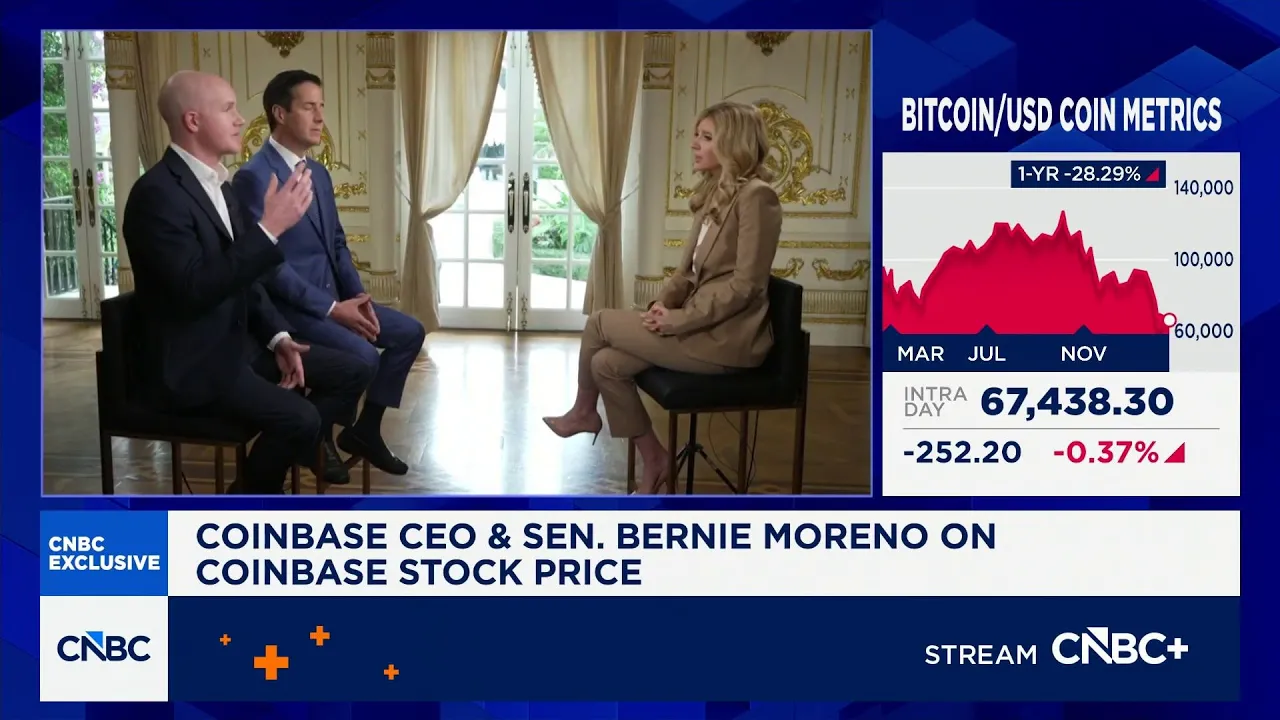
Coinbase CEO Brian Armstrong and Senator Bernie Moreno (R-Ohio), one of the lead negotiators in Washington and a former crypto entrepreneur himself, sat down at the World Liberty Forum in Mar-a-Lago to lay out exactly where things stand.
After years of regulatory uncertainty that pushed crypto activity offshore and left American companies operating in legal grey areas, the industry is now closer than ever to getting the clear legislative framework it has been pushing for.
The bottom line of the interview highlights that a deal is close, the White House is all-in, and the target is April.
Two Bills, One Goal: Understanding the Crypto Legislation Pipeline
There are actually two separate bills being discussed in the conversation:
The GENIUS Act: Specifically the stablecoin bill. This is what the rewards/yield debate is about. President Trump actually signed it into law on July 18, 2025.
The Digital Asset Market Clarity Act (CLARITY Act): The broader market structure bill covering crypto assets more generally.
GENIUS Act Explained: What the First U.S. Stablecoin Law Actually Does
The GENIUS Act, short for the Guiding and Establishing National Innovation for U.S. Stablecoins Act, establishes the first federal regulatory framework for payment stablecoins in the United States.
The legislation sets clear rules for how digital dollars must be backed, supervised, and disclosed, aiming to formalize stablecoins within the U.S. financial system.
Here's what the law does and why it matters:
Federal framework: Creates the first nationwide regulatory structure specifically for payment stablecoins
1:1 Reserve requirement: Stablecoins must be fully backed by U.S. dollars or highly liquid assets such as short-term U.S. Treasuries
Mandatory oversight: Issuers are subject to bank-like supervision and regulatory standards
Monthly transparency: Companies must publish regular public reports detailing reserve composition
Creditor priority: In the event of insolvency, stablecoin holders receive priority over other creditors
No yield provision: The final version prohibits stablecoin issuers from offering interest or rewards to holders, the same stablecoin rewards debate referenced in the Armstrong–Moreno discussion
The Central Fight: Stablecoin Rewards
At the centre of the debate is a simple but consequential question: should digital dollars be allowed to pay interest?
Core dispute: Lawmakers are divided over whether stablecoin issuers can offer rewards or yield to holders
Bank opposition: Traditional banks see yield-bearing stablecoins as a direct threat to their deposit base
Consumer framing: Armstrong and Moreno argue this is one of the clearest consumer wins available
Public frustration: Armstrong cites polling showing 87% of Americans feel the current financial system doesn't work for them
Competition for cash: Stablecoin rewards would force real competition, allowing people to earn meaningful yield on money sitting in their wallet or account
System pressure: More competition could mean fewer fees, faster settlement, and more equal access to financial services
Stablecoin Yields: How the Interest Payment Debate Shaped the Final Law
The yield fight didn't stay in the negotiating room, it spilled into Congress, forced a dramatic withdrawal, and ultimately determined what the GENIUS Act became.
The bank argument: Traditional financial institutions warned that yield-bearing stablecoins would pull deposits away from community banks and destabilize the broader banking system
The crypto counter: Armstrong and others argued that restricting yields would hand the advantage to offshore, unregulated competitors already paying interest, accelerating the very capital flight the law was meant to prevent
The GENIUS Act compromise: The final law bars stablecoin issuers from paying direct interest to holders, but stops short of prohibiting third-party platforms from offering their own rewards programs, leaving a meaningful door open for exchanges like Coinbase
Coinbase's role in the fight: The exchange withdrew its support ahead of a Senate Banking Committee vote, citing yields as a central concern, a move that reshuffled the entire negotiation and brought all parties back to the table
The Global Stakes: China, Offshore Stablecoins, and the Dollar
The debate extends far beyond Washington, a global race for digital dollar dominance is accelerating.
China moving first: China is rolling out a central bank digital currency that pays interest
Offshore growth: Unregulated offshore stablecoins already exceed those operating within the U.S. regulatory framework
Repatriation goal: President Trump has said he wants that activity brought back under U.S. jurisdiction
Legislative warning: Armstrong argues that without stablecoin rewards included in legislation, that capital will not return
Dollar strength argument: Moreno contends stablecoins wouldn't weaken the dollar, they would expand global dollarization
Treasury demand impact: Increased stablecoin adoption could drive significant demand for U.S. Treasuries, potentially lowering America's borrowing costs by hundreds of billions annually
Did Coinbase Block the Bill?
Amid claims that Coinbase stalled progress, Armstrong offered a different account, one on negotiation:
Pushing back: Armstrong rejected the idea that Coinbase "blocked" the bill
Draft concerns: He said the company raised substantive issues with the existing language, prompting renewed negotiations
Back to the table: All sides are now re-engaged, working toward a revised framework
Three-way win: Armstrong believes the outcome can benefit crypto firms, banks, and consumers alike
White House involvement: Armstrong said the administration, with David Sachs named as crypto czar, appears to be meeting daily on the legislation, though he acknowledged he couldn't confirm this directly
Bitcoin Is Down: Does It Matter?
Despite Bitcoin's rough start to 2026, Coinbase leadership is still leaning in:
Calm on the drawdown: Armstrong dismissed the decline as short-term volatility
Buying the dip: Coinbase is accumulating Bitcoin and repurchasing its own stock
Long-term thesis: Bitcoin remains the best-performing asset of the past decade
Stronger than gold?: Senator Moreno said he would choose Bitcoin over gold if allocating capital today
Zooming out: Both emphasized that temporary price swings are noise, the real story is the infrastructure being built underneath
What About Quantum Computing Breaking Blockchain?
Armstrong dismissed fears about quantum computing breaking blockchain as simply "not true." He pointed to Coinbase's quantum advisory council already coordinating with major blockchains on a post-quantum cryptography upgrade path. Quantum is a solvable problem, he said and Coinbase is already working on it.
Prediction Markets: The CFTC Takes On the States
A major regulatory shift could reshape the future of U.S. prediction markets and directly impact Coinbase's long-term expansion strategy.
CFTC pushback: The agency is forcefully opposing state attempts to classify prediction markets as gambling
Federal authority: Commissioner Mike Selig stated that the CFTC holds exclusive federal jurisdiction over these contracts
Legal showdown ahead: Legal challenges from states are expected and could escalate to the Supreme Court
Confidence in the law: Armstrong believes the statutory framework clearly favors the CFTC's authority
Strategic implications for Coinbase: As Coinbase builds the "Everything Exchange" crypto, equities, commodities, and prediction markets, regulatory clarity is critical to its expansion
One Disclosure Worth Noting
Coinbase donated to Senator Moreno's super PAC. Moreno's response was characteristically direct, they agreed with him, not the other way around.
자주 묻는 질문
What does the GENIUS Act do for U.S. stablecoins?
The GENIUS Act creates the first federal regulatory framework for payment stablecoins, requiring 1:1 reserves in dollars or highly liquid assets, bank-like supervision, monthly public reserve reports, creditor priority for holders in insolvency, and it prohibits issuers from paying interest or rewards to holders.
Why are stablecoin rewards such a central point of controversy?
Lawmakers are split on whether stablecoin issuers should be allowed to offer yield, with banks warning that interest-bearing stablecoins could drain deposits and destabilize the system, while Armstrong and Moreno argue that allowing rewards would be a major consumer benefit, increase competition for cash, and pressure the system toward lower fees, faster settlement, and broader access.
How did the yield debate shape the final GENIUS Act compromise?
Traditional banks argued yields would harm community banks, while crypto advocates warned that banning yields would push activity offshore. The final GENIUS Act bars issuers from paying direct interest but leaves room for third-party platforms, such as exchanges, to offer their own rewards programs, a compromise that followed Coinbase withdrawing support over yield concerns and forcing renewed negotiations.
Did Coinbase block progress on the crypto legislation?
Brian Armstrong rejected claims that Coinbase blocked the bill, saying the company raised substantive concerns with the draft language, which brought all parties back to the table. He now sees all sides re-engaged toward a revised framework that could benefit crypto firms, banks, and consumers, with the White House heavily involved through its designated crypto czar.
면책 조항
이 글에 제공된 정보는 정보 제공을 위한 것입니다. 이는 금융 자문으로 간주되어서는 안 되며, 금융 자문을 의미하지 않습니다. 우리는 이 정보의 완전성, 신뢰성, 정확성에 대해 어떠한 보증도 하지 않습니다. 모든 투자는 위험을 수반하며 과거의 실적이 미래의 결과를 보장하지 않습니다. 투자 결정을 내리기 전에 금융 자문가와 상담할 것을 권장합니다.