










Bitcoin Nodes Without Internet
  • $

    Loading

    미국 달러

  • $

    Loading

    미국 달러

  • $

    Loading

    미국 달러

  • $

    Loading

    미국 달러

  • $

    Loading

    미국 달러

  • $

    Loading

    미국 달러

  • $

    Loading

    미국 달러

  • $

    Loading

    미국 달러

  • $

    Loading

    미국 달러

  • $

    Loading

    미국 달러

  • $

    Loading

    미국 달러

  • $

    Loading

    미국 달러

  • $

    Loading

    미국 달러

  • $

    Loading

    미국 달러

  • $

    Loading

    미국 달러

  • $

    Loading

    미국 달러

  • $

    Loading

    미국 달러

  • $

    Loading

    미국 달러

  • $

    Loading

    미국 달러

  • $

    Loading

    미국 달러

Can Bitcoin Survive Without the Internet? What Node Data Actually Shows

앤드류 캄스키

2026. 2. 24.

읽기 시간

14 mins

공유하기

오디오로 듣기

0:00/1:34

Can Bitcoin Survive Without the Internet? What Node Data Actually Shows

빠른 요약

  • Bitcoin pauses during complete internet outages, but the ledger and ownership remain intact

  • Random cable or infrastructure failures barely affect global node counts; risk rises sharply with coordinated, targeted attacks

  • Bitcoin's node network withstands random losses but fragments quickly when highly connected nodes or hosting providers are removed

  • Sustained node attrition quietly erodes consensus security, though satellites, TOR, and radio add partial resilience

It’s easy to assume that if the Internet disappears, Bitcoin disappears with it. Most people experience Bitcoin through websites and apps, so the connection feels automatic. But they are not the same thing. They operate separately, and understanding that difference helps clarify how Bitcoin actually works and what it depends on.

Bitcoin is a peer-to-peer network, a web of computers called nodes that talk to each other to agree on a shared ledger. The Internet is the plumbing the protocol runs on. Bitcoin uses it to pass transactions around and reach consensus on which blocks get added to the chain. But the ledger itself, the entire history of every transaction ever made, lives as a local copy on thousands of machines worldwide.

If the Internet Switched Off Completely

If the Internet switched off completely Bitcoin would not vanish, but the network would enter a temporary standstill until global connectivity is restored.

  • Transactions freeze: No new transactions can be broadcast or confirmed, and the mempool falls silent as activity stops.

  • Mining halts: Miners cannot share or receive blocks, which means no new Bitcoin is issued and no transaction fees are processed.

  • The ledger survives: Every node retains its full copy of the blockchain, preserving the entire transaction history in a frozen state.

  • Ownership remains intact: Private keys still prove control over funds, even though coins cannot be moved without network communication.

  • Recovery resumes automatically: Once connections return, nodes synchronize, resolve any competing chains using the longest chain rule, and continue from the last valid block.

A global Internet outage would not destroy Bitcoin. It would simply pause the system until communication is restored.

Could a Targeted Attack Bring Bitcoin Down: Measuring Infrastructure Resilience

Random infrastructure failures pose far less risk to Bitcoin than many assume. Empirical research shows that accidental cable cuts and regional outages rarely move global node counts in a meaningful way. This implies the Bitcoin network is structurally resilient to randomness. 

What the data does reveal, however, is a different kind of vulnerability: not to accidents, but to coordinated, precision targeting of critical infrastructure and routing concentration. Research illustrates:

  • Random failures show minimal impact: Researchers at the University of Cambridge tracked 68 verified submarine cable faults between 2014 and 2025 and found that 87 percent caused less than a 5 percent change in global node count, with an average impact of negative 1.5 percent.

  • Even severe regional outages barely register globally: In 2024, when seven or eight submarine cables were damaged off the coast of Côte d'Ivoire, disrupting internet access across 13 West and Central African countries, the global Bitcoin node count shifted only about negative 2.5 percent, well within normal daily fluctuation, largely because the region hosted relatively few nodes.

  • Random fragmentation requires extreme conditions: More than 70 percent of inter-country submarine cables would need to fail simultaneously to seriously fragment the network, a scenario with no historical precedent or realistic failure mechanism.

  • Targeted cable attacks lower the disruption threshold: While more than 70 percent of global inter-country cables would need to fail randomly to fragment the network, a coordinated strike focused only on the most central high-traffic routes, particularly the 11 key Europe–North America connections, could cause comparable disruption by cutting roughly 20 percent of those strategically critical cables.

  • Routing concentration creates additional exposure: Because many Bitcoin nodes are hosted within a small number of major infrastructure providers, such as Hetzner, OVH, and Amazon, disrupting roughly 5 percent of strategically central routing capacity, particularly where node hosting is concentrated, could be enough to cause meaningful network fragmentation.

  • Geographic dispersion is the primary defense: When nodes are widely distributed, resilience increases; when they cluster, as during peak mining concentration in 2021, the network becomes measurably more fragile.

Bitcoin is engineered to withstand accidents. Its meaningful exposure lies not in randomness, but in precision.

How Vulnerable Is Bitcoin's Node Network Itself?

The cable and routing layer tells one part of the story. However, there is a second, more direct vulnerability sitting inside Bitcoin's peer-to-peer network, at the level of the nodes themselves. 

Researchers at the Cyprus University of Technology spent 28 days crawling Bitcoin and six other blockchain networks, including Ethereum, Dash, Dogecoin, Litecoin, Bitcoin Cash and Zcash, mapping all potential connections between peers and stress-testing what it actually takes to break them.

The results split cleanly into two worlds depending on how the attack is carried out.

  • Random failures cause surprisingly little damage: Nodes going offline by accident, hardware failures, power cuts, ISPs going down, had limited structural effect. The network absorbed them without significant disruption, consistent with what the Cambridge cable study found at the physical layer. Bitcoin was designed with exactly this kind of failure in mind, and that design holds up.

  • Targeted removal is a different story entirely: When researchers ranked Bitcoin nodes by their importance to the network and began removing the most connected ones first, the largest connected component dropped by 40 percent after just the first five removals. Ten targeted node removals were enough to reduce the network to half its functional size.

  • Partition means more than disconnection: When the network splits into isolated islands, nodes within each partition do not simply lose contact with the other side they lose awareness that the other side exists at all. They cannot form new links across the divide because they have no knowledge of nodes beyond their own partition. The split becomes self-reinforcing and invisible from the inside.

  • Hosting concentration adds another layer of exposure: Around 20 percent of Bitcoin's most highly connected nodes were found sitting inside a single Autonomous System, a single hosting provider or network operator. A coordinated strike on that one provider, through a DDoS attack or a BGP routing manipulation, could remove that entire cluster in one move.

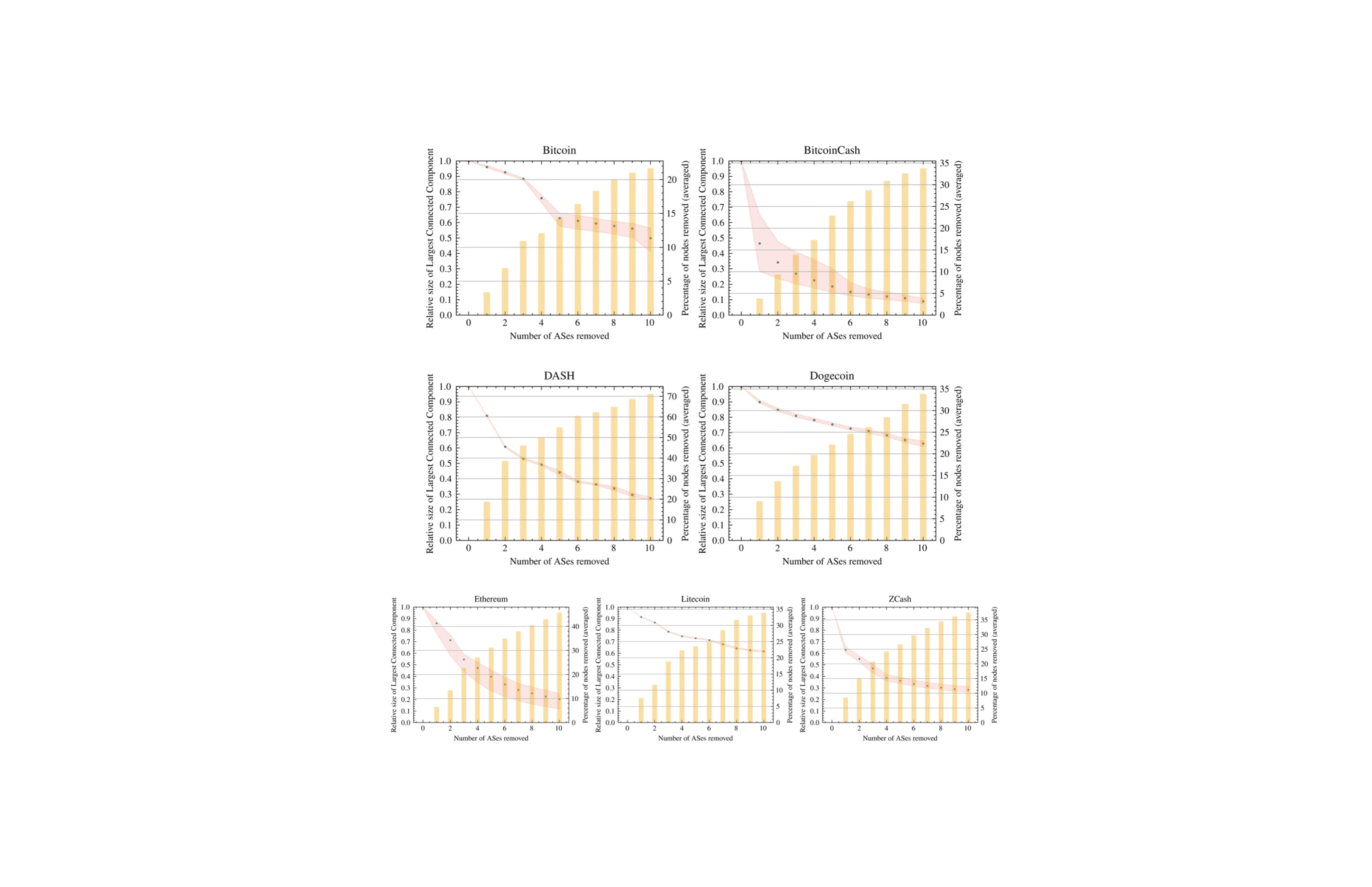
Figure from Paphitis et al. (2023): Effect of targeting the top 10 Autonomous Systems (hosting providers) by node concentration across seven blockchain networks. The pink line shows the relative size of the largest connected component remaining after each AS removal. Steeper pink lines and taller yellow bars indicate greater vulnerability to infrastructure-level attack.

An Autonomous System attack targets the hosting providers and network operators directly, rather than individual nodes or cables. When researchers simulated targeted attacks against the top 10 Autonomous Systems, the hosting providers and network operators where nodes concentrate, across all seven networks, found:

  • Bitcoin: Most resilient. No single provider dominates, highly connected nodes are scattered widely, and the network degrades gradually even after 10 AS removals

  • Dogecoin: Surprisingly close second. Declines gradually like Bitcoin with no obvious concentration points counter to most assumptions about Dogecoin's technical standing

  • Litecoin: Moderate vulnerability. Steeper early drops than Bitcoin or Dogecoin, with meaningful provider concentration but nothing catastrophic.

  • ZCash: Sharp early drop then continued decline. Middle of the pack, better than Ethereum and BitcoinCash, worse than Bitcoin and Dogecoin

  • DASH: Concentrated and vulnerable. Single ASes host over 60 percent of total nodes in some cases, with steep decline throughout

  • Ethereum: Sharp collapse by the second or third AS removal despite being the second largest blockchain by most measures

  • BitcoinCash: Most fragile. Effectively collapses after just two or three provider removals.

All of the above assumes a partial attack targeting specific providers, cables, or nodes while the rest of the network continues to function. Yet there is a more absolute question worth asking. 

The more unsettling question is not what happens under partial pressure, but what happens if that pressure never stops.

What Happens if the Bitcoin Network Starts to Shrink?

In theory, Bitcoin can function on a single node. The protocol has no minimum requirement. However, a network of one is not really a network. A single node cannot reach consensus with itself, validate external transactions, or propagate new blocks to anyone.

More importantly, the danger isn't just the final node going dark. This is what researchers call the shutdown problem, formalized by Day (2019), and it reveals something subtler than a simple off switch.

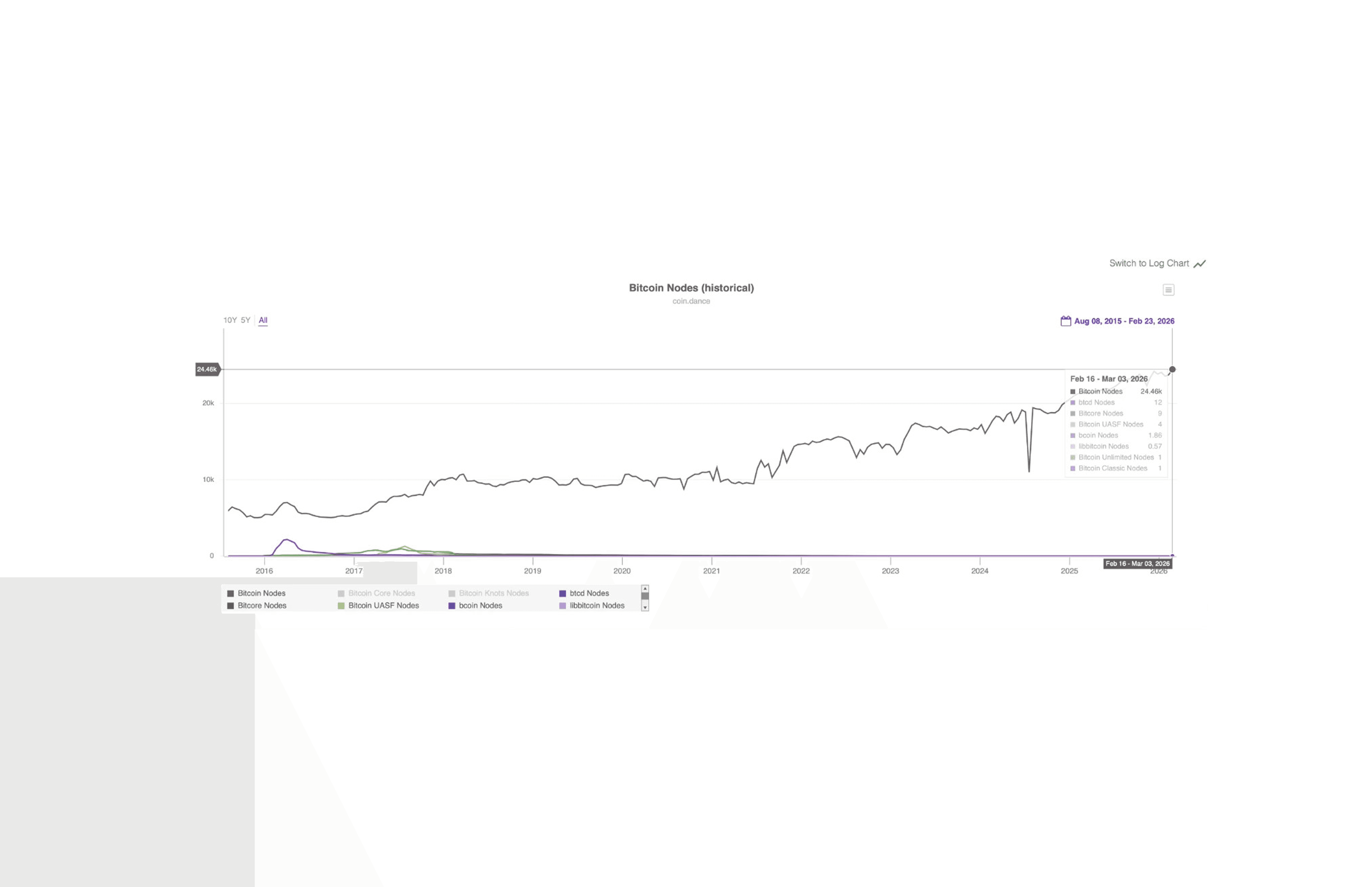
Bitcoin Nodes historical | Source: coin.dance

Bitcoin's security is not binary. Bitcoin does not simply work or fail. It is conditional, and that condition is the health of the network that sustains it.

If that network thins, the system does not abruptly collapse but gradually becomes easier to corrupt.

  • Unstable consensus model: Bitcoin operates under what Day classifies as unstable consensus, meaning recent blocks are probabilistic rather than final and can theoretically be rewritten if enough dishonest influence accumulates.

  • Security through scale: With 24,000 or more honest nodes participating, rewriting transaction history is economically unrealistic because the cost of coordination and attack outweighs any potential gain.

  • Erosion through attrition: As nodes leave the network due to disruption or contraction, the economic and structural barriers to revising recent blocks quietly weaken.

  • No clear tipping point: The network does not fail at a single identifiable moment; instead, it becomes progressively less trustworthy without an obvious threshold signaling compromise.

  • The smallest network is the weakest: The fewer nodes that remain, the easier it becomes for a dishonest actor to influence consensus, making extreme contraction inherently dangerous.

  • No graceful termination mechanism: Bitcoin has no built-in off switch or formal process to declare the ledger complete and permanently frozen, meaning it must rely on active consensus rather than a final state.

If honest nodes abandon it, dishonest ones can rewrite its recent history without anyone left to stop them.

What Keeps Bitcoin Running When the Internet Fails?

The community hasn't been passive about resilience. Three layers act as backup infrastructure when traditional Internet connections fail and together they address both the connectivity problem and the corruption problem that Day's shutdown research identified.

  • Blockstream Satellite: Broadcasts the entire Bitcoin blockchain from geostationary orbit, around the clock. Anyone with a small dish and receiver can download the complete blockchain without any Internet connection. The catch: it's one-way. You can receive blocks but cannot broadcast transactions back up. Read-only coverage, useful for keeping nodes synced and the ledger preserved, not for spending.

  • TOR: A growing share of Bitcoin nodes route traffic through TOR, the anonymizing overlay network, creating connectivity that doesn't depend on clearnet infrastructure alone. Research shows TOR adoption improves network resilience by roughly 2–10% not transformative, but meaningful. Interestingly, the resilience benefit comes not from the anonymization itself but from TOR relay bandwidth being concentrated in well-connected European countries that are hard to isolate.

  • Darkwire amateur radio: Experimental but real. Projects like Darkwire use LoRa long-range radio mesh networks to relay Bitcoin transactions with no Internet involved at all. Still experimental and early stage.

None of these are silver bullets. Satellites can't send transactions back. TOR adds modest resilience but doesn't eliminate the hosting concentration risk. Radio remains experimental. 

Together they mean the network has multiple independent fallback layers, each one keeping more honest nodes online, which is exactly what the shutdown problem says matters most.

Conclusion

Bitcoin does not depend exclusively on the public Internet. The ledger lives on thousands of machines worldwide and can be transmitted through multiple communication channels, including satellite. What it requires is connectivity of some kind. A network layer that allows value to move, transactions to confirm, and consensus to form.

A complete Internet blackout would freeze Bitcoin in place, not destroy it. The moment connectivity returned, even partially, nodes would reconcile, the longest chain would prevail, and the system would resume as if paused.

The real risk is not a sudden outage but a sustained, coordinated attack on critical infrastructure: submarine cables, backbone routers, hosting providers, and routing systems, combined with pressure on Bitcoin’s overlay networks, maintained long enough for honest participation to thin and corruption to take hold.

That scenario would require state-level resources, coordination across adversarial jurisdictions, and patience measured in months or years. It is theoretically possible. It is extraordinarily unlikely in practice.

Bitcoin’s resilience is real, but not mystical. With satellites, Tor, radio experiments, and tens of thousands of nodes distributed globally, a clean kill shot would resemble attempting to destroy every copy of a book at once and reaching every hard drive before someone boots a surviving archive and starts the network again.

자주 묻는 질문

What happens to Bitcoin if the Internet switches off completely?

Bitcoin does not vanish but enters a temporary standstill: transactions cannot be broadcast or confirmed, mining halts, and the mempool goes silent. Each node keeps its full copy of the blockchain, ownership remains provable via private keys, and once connectivity returns, nodes resynchronize using the longest chain rule and continue from the last valid block.

How do random infrastructure failures compare to targeted attacks on Bitcoin’s connectivity?

Random failures such as accidental submarine cable cuts and regional outages have shown minimal impact on global node counts and rarely fragment the network. In contrast, coordinated attacks focusing on critical submarine cables, central routing capacity, or concentrated hosting providers can lower the disruption threshold and potentially cause meaningful network fragmentation.

What is the shutdown problem and why does a shrinking Bitcoin node network matter?

The shutdown problem describes how Bitcoin’s security weakens as its node network contracts. Because Bitcoin uses unstable consensus, recent blocks are only probabilistically final; with many honest nodes (e.g., 24,000 or more), rewriting history is economically unrealistic, but as nodes leave, it becomes progressively easier for dishonest actors to influence consensus. There is no clear tipping point or built-in mechanism to gracefully terminate and permanently freeze the ledger.

What backup communication channels can keep Bitcoin running when traditional Internet access fails?

Three main layers provide backup: Blockstream Satellite, which broadcasts the blockchain from orbit for read-only synchronization without Internet; Tor, which routes node traffic through an overlay network and improves resilience by about 2–10%; and experimental Darkwire amateur radio, which uses long-range LoRa mesh networks to relay Bitcoin transactions without Internet. These are not complete solutions individually but together help keep more honest nodes online.

면책 조항

이 글에 제공된 정보는 정보 제공을 위한 것입니다. 이는 금융 자문으로 간주되어서는 안 되며, 금융 자문을 의미하지 않습니다. 우리는 이 정보의 완전성, 신뢰성, 정확성에 대해 어떠한 보증도 하지 않습니다. 모든 투자는 위험을 수반하며 과거의 실적이 미래의 결과를 보장하지 않습니다. 투자 결정을 내리기 전에 금융 자문가와 상담할 것을 권장합니다.


공유하기

작성자

앤드류 캄스키

2026. 2. 24.

비트코인과 알트코인을 청산, 지표 또는 추측 없이 거래하세요

두려움 속에서 구매하고 회복 중에 판매하는 간단한 반복 가능한 프레임워크입니다. 청산 위험이나 하루 종일 차트를 보는 위험 없이 가능합니다.

신호, 전문가, 또는 운에 의존하지 마십시오. 일단 보면 잊을 수 없는 너무나도 간단한 시스템을 배우세요. 완전히 소유하고 영원히 사용하세요.

비트코인과 알트코인을 청산, 지표 또는 추측 없이 거래하세요

두려움 속에서 구매하고 회복 중에 판매하는 간단한 반복 가능한 프레임워크입니다. 청산 위험이나 하루 종일 차트를 보는 위험 없이 가능합니다.

신호, 전문가, 또는 운에 의존하지 마십시오. 일단 보면 잊을 수 없는 너무나도 간단한 시스템을 배우세요. 완전히 소유하고 영원히 사용하세요.

비트코인과 알트코인을 청산, 지표 또는 추측 없이 거래하세요

두려움 속에서 구매하고 회복 중에 판매하는 간단한 반복 가능한 프레임워크입니다. 청산 위험이나 하루 종일 차트를 보는 위험 없이 가능합니다.

신호, 전문가, 또는 운에 의존하지 마십시오. 일단 보면 잊을 수 없는 너무나도 간단한 시스템을 배우세요. 완전히 소유하고 영원히 사용하세요.

비트코인과 알트코인을 청산, 지표 또는 추측 없이 거래하세요

두려움 속에서 구매하고 회복 중에 판매하는 간단한 반복 가능한 프레임워크입니다. 청산 위험이나 하루 종일 차트를 보는 위험 없이 가능합니다.

신호, 전문가, 또는 운에 의존하지 마십시오. 일단 보면 잊을 수 없는 너무나도 간단한 시스템을 배우세요. 완전히 소유하고 영원히 사용하세요.