










빠른 요약
Bitcoin block space is limited, and periods of heavy inscription activity increase non-financial data usage
BIP-110 proposes temporary consensus limits on output size, OP_RETURN usage, and witness elements, with restrictions set to expire after roughly one year
Support remains limited to some nodes, no mining pools, amid concerns about decentralization impacts
Article talks about how incentives outlast temporary rules, recommending long-term solutions like Layer2, node efficiency, fee markets
Bitcoin’s block space is intentionally limited. Since 2023, an increasing portion of that space has been used for transactions embedding non-financial data, such as inscriptions, token metadata, media, and files, alongside standard payment transfers.
Whether this activity is considered spam or a legitimate use of the network depends on perspective, and that interpretation tends to influence reactions to any proposals that follow.
What Counts as Spam on Bitcoin?
Bitcoin's protocol does not distinguish between a payment and a piece of data.
A transaction either meets the validation rules or it does not. There is no field that declares purpose. Any definition of spam has to come from outside the protocol, from humans deciding which uses of block space are acceptable.
In practice, two categories draw the most criticism.
Ordinal inscriptions: Embed arbitrary data like images, audio, text, collectibles into individual satoshis. Each inscription occupies block space that might otherwise process financial transactions. Since early 2023, inscriptions have represented a noticeable portion of on-chain activity, contributing to higher fees and increasing the amount of data full nodes must store permanently.
Dust outputs: Scattered microscopic amounts of bitcoin across thousands of addresses. Too small to spend economically, they sit in the UTXO set indefinitely, increasing the storage burden on node operators.
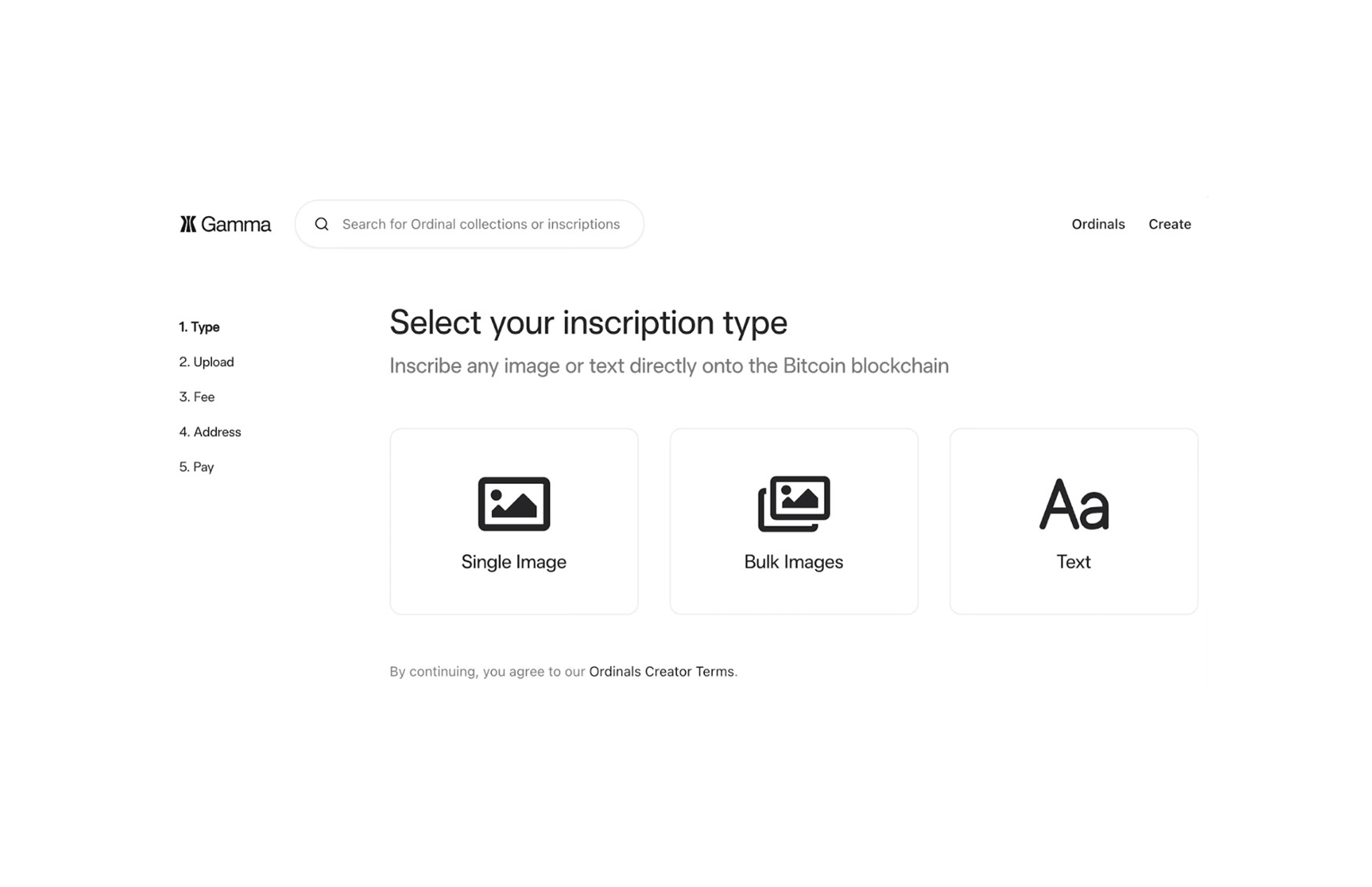
Website to upload inscriptions | Source: https://ordinals.gamma.io/create
Both activities create fee pressure.
When blocks fill with non-financial data, payment senders compete harder for confirmation and smaller transactions get priced out.
The net effect is a network where demand for block space increasingly comes from uses beyond simple value transfer. Whether that demand is legitimate depends entirely on how you define Bitcoin's purpose.
Why BIP-110 Entered the Conversation
BIP-110, numbered BIP-444 in some implementations and community references, is a temporary soft fork proposed by developer Dathon Ohm and supported by Bitcoin Knots maintainer Luke Dashjr. The proposal responds directly to the spam debate and specifically to Bitcoin Core version 30's removal of the longstanding 83-byte OP_RETURN relay limit on October 11, 2025.
BIP-110 introduces temporary consensus limits aimed at reducing non-financial data usage on the base layer.
Output Size Cap: New transaction outputs would be limited to 34 bytes.
OP_RETURN Limit: The OP_RETURN relay limit would be restored to 83 bytes.
Witness Element Cap: Individual witness elements would be restricted to 256 bytes.
Automatic Expiration: All restrictions would expire after 52,416 blocks approximately one year.
As of February 2026, approximately 6–7% of reachable nodes run BIP-110 code based on version string signaling, almost entirely through Bitcoin Knots. Yet, no mining pools have signaled consensus-level support. Supporters of BIP-110 argue that unchecked data growth raises node costs and concentrates validation power among well-resourced operators, weakening decentralization over time.
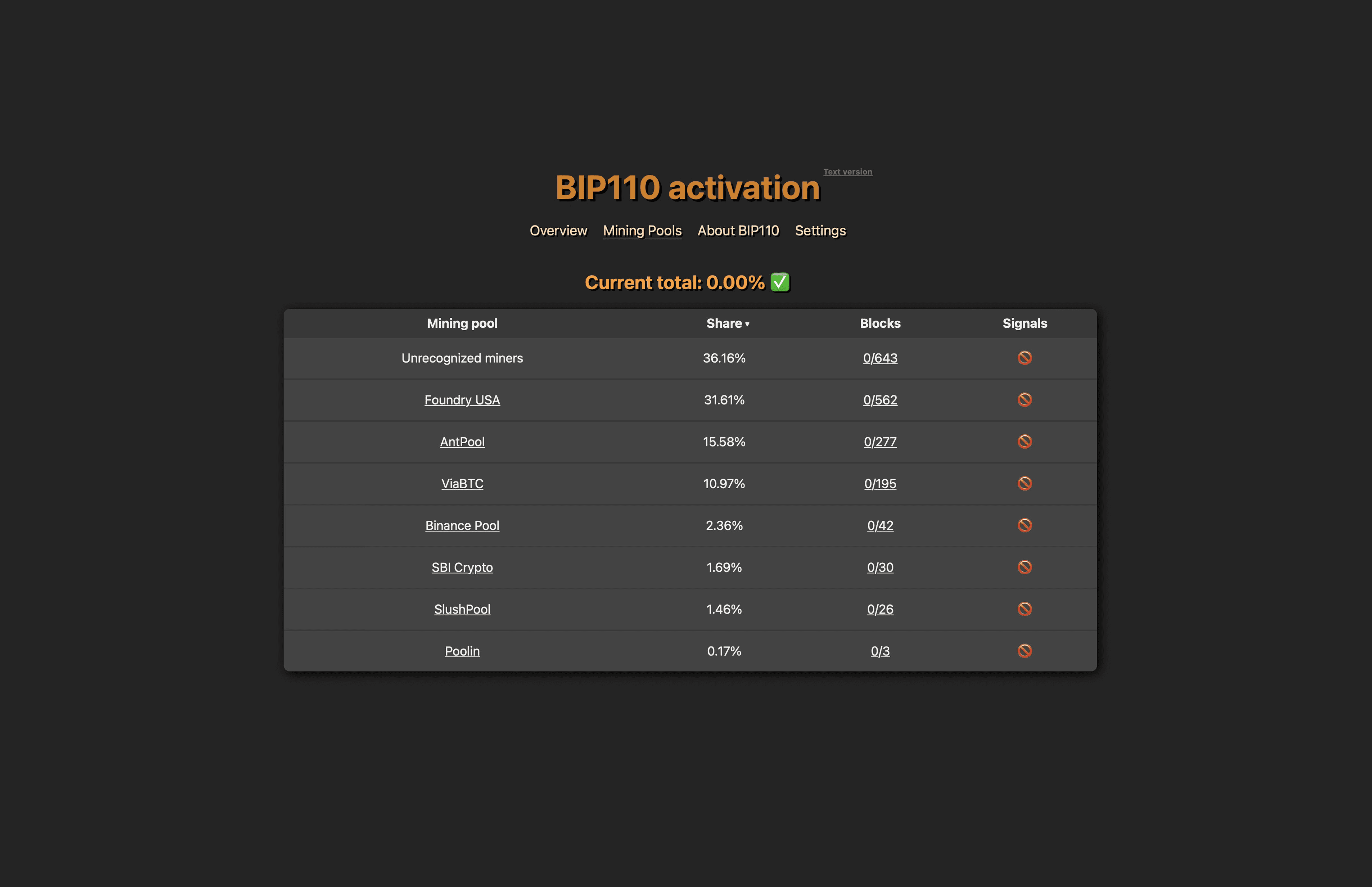
BIP-110 Activation | Source: https://filters.watch/miners
A Temporary Fix Cannot Change How People Act
BIP-110 is designed to expire.
The assumption is that a 12-month breathing period gives developers room to build a permanent solution. Yet protocol restrictions do not alter human motivation.
If inscribing data on Bitcoin remains profitable or culturally rewarding, participants will find ways around the caps encoding payloads in alternative transaction fields, splitting data across smaller transactions, or migrating to structures that technically comply while achieving the same outcome.
Casa CTO Jameson Lopp has publicly dismissed the claim that relaxing OP_RETURN limits introduces new vulnerabilities or increases node burden, calling such arguments "false narratives."
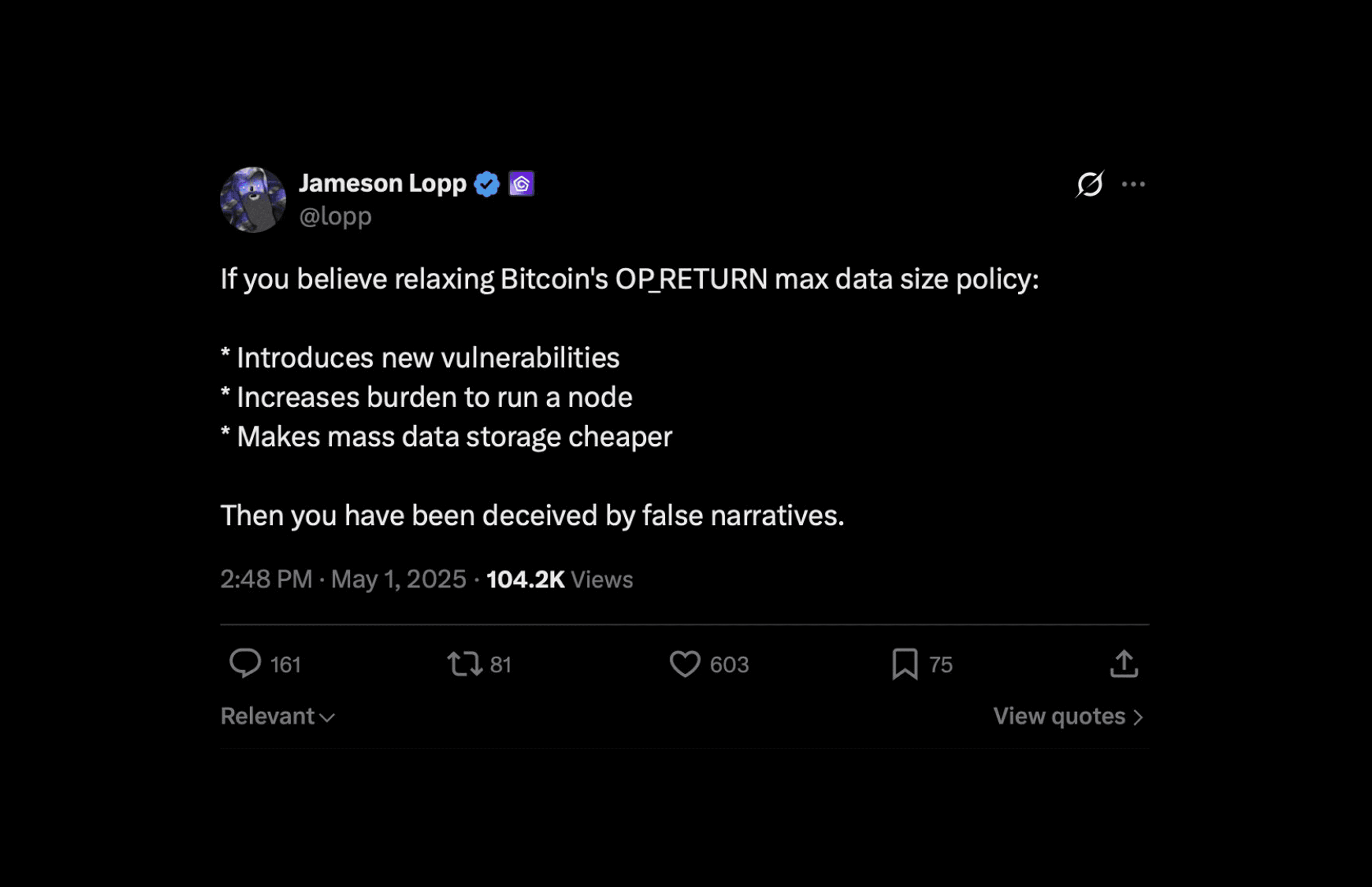
Jameson Lopp on OP_RETURN | Source: https://x.com/lopp/status/1917924032487260192
Bitcoin already prices block space through fees. Adding consensus-level filters on top introduces a second layer of judgement about what counts as a valid use and misjudging the functionality of OP_RETURN has consequences.
The Real Tension: Money or Platform?
Every spam debate circles back to an identity question that no protocol patch can settle.
Knots-oriented minimalists: Tend to emphasize Bitcoin as a narrowly focused monetary system. From this perspective, block space is scarce infrastructure that should prioritize value transfer and settlement. Consensus limits that discourage non-monetary data are seen as protective measures for decentralization.
Core-aligned market neutralists: Often frame block space as a neutral fee market. Any transaction that follows consensus rules and pays the required fee competes legitimately, regardless of purpose. The protocol enforces validity, not intent.
Protocol Stewards: Occupy a middle position. While recognizing that Bitcoin is permissionless and fee-driven, stewards argue that not all technically valid uses are aligned with long-term network health. The community, in their view, has a role in preserving Bitcoin’s focus without crossing into content-based censorship.
All three positions are internally coherent. The disagreement is social, not technical which is exactly why a time-limited code change cannot resolve it on its own.
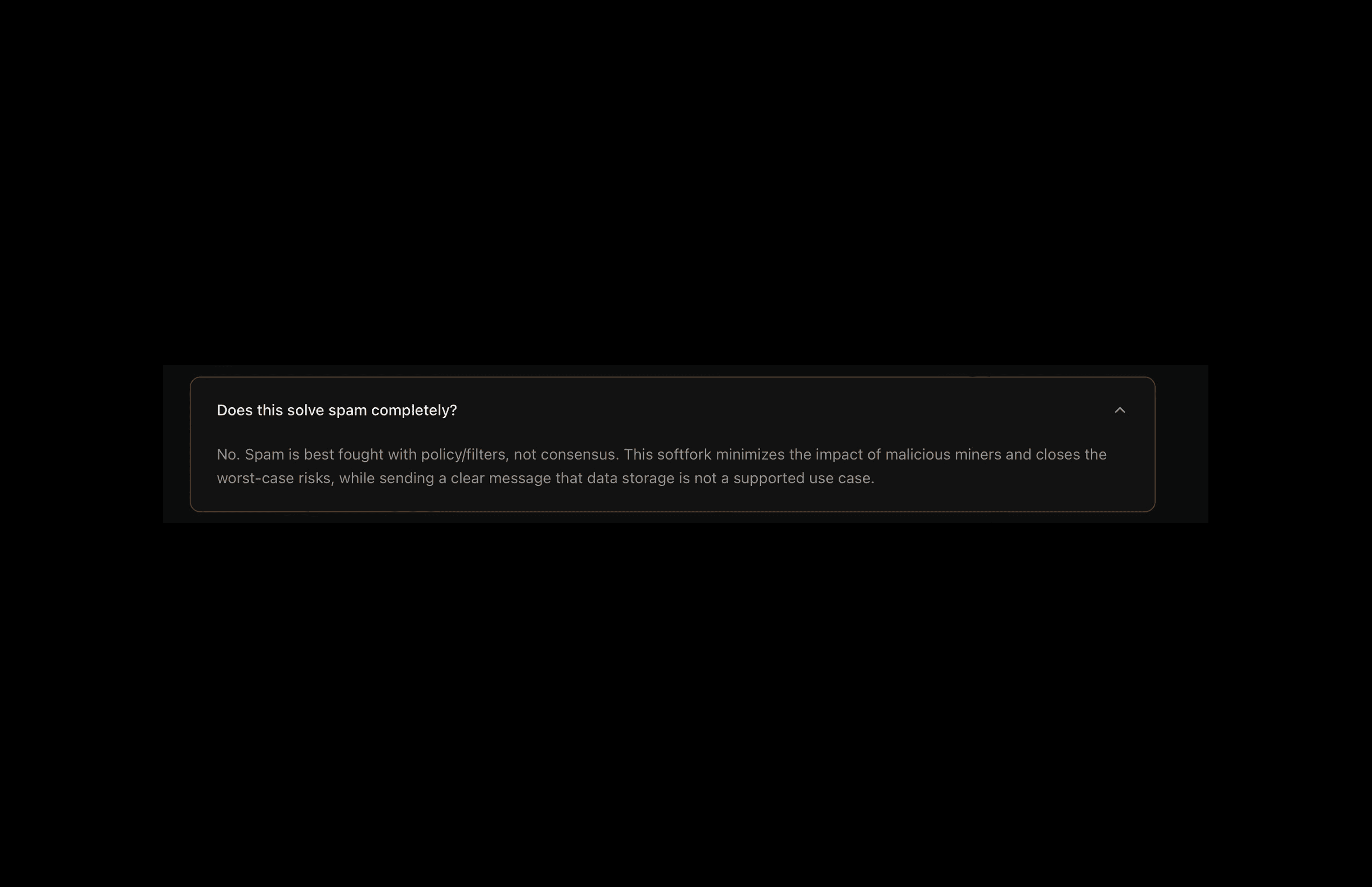
Does BIP-110 solve spam completely? | Source: BIP-110
What Matters Going Forward
Rather than relying on a temporary consensus cap, addressing block space pressure likely requires structural, long-term adjustments in the form of:
Layer 2 adoption: Pushing micropayments and high-frequency transactions to Lightning reduces on-chain congestion without restricting what data can exist on the base layer
Node efficiency: Projects aimed at shrinking the storage and memory burden of running a full node (such as Utreexo and AssumeUTXO) make decentralization more resilient to data growth regardless of its source.
Fee market maturity: As Bitcoin's block subsidy declines through future halvings, transaction fees become a larger share of miner revenue. A functioning fee market may naturally price out low-value data usage without requiring consensus-level intervention.
Conclusion
BIP-110 highlights a real problem. Block space is finite, demand is growing, and the question of what belongs on Bitcoin's base layer remains a broad discussion. A 12-month data cap may buy time, reduce short-term bloat, and shift norms around intended usage.
Yet expecting a temporary protocol rule to reshape how millions of participants use a permissionless network overestimates what code accomplishes on its own. Human behaviour follows incentives, not expiration dates. The spam debate will outlast any single proposal because it is not really about spam at all. It is about what Bitcoin is for.
Even BIP-110's own authors acknowledge the proposal cannot solve spam completely, describing its proposal as a measure that "sends a clear message that data storage is not a supported use case" rather than a technical fix.
For more on how Taproot's features connect to this debate, read: Taproot: Bitcoin's Biggest Upgrade Since SegWit And Why It Still Matters.
자주 묻는 질문
What kinds of Bitcoin activity are most often criticized as spam?
Two main categories draw criticism: ordinal inscriptions, which embed arbitrary data like images, audio, text, and collectibles into individual satoshis, and dust outputs, which scatter microscopic amounts of bitcoin across thousands of addresses that are too small to spend economically and increase the UTXO set.
What is BIP-110 and what temporary limits does it propose?
BIP-110 is a temporary soft fork proposed by Dathon Ohm and supported by Luke Dashjr that introduces consensus limits to reduce non-financial data on Bitcoin’s base layer. It would cap new transaction outputs at 34 bytes, restore the OP_RETURN relay limit to 83 bytes, restrict individual witness elements to 256 bytes, and have all these restrictions automatically expire after 52,416 blocks, around one year.
Why is BIP-110 considered unable to permanently solve the spam problem?
BIP-110 is designed to expire after about a year and does not change underlying incentives. If embedding data on Bitcoin remains profitable or culturally rewarding, participants can work around the caps by using alternative transaction fields, splitting data across smaller transactions, or adopting structures that technically comply while achieving the same outcome.
What are the main perspectives in the debate over Bitcoin spam and block space use?
Knots-oriented minimalists emphasize Bitcoin as a focused monetary system and favor limits that prioritize value transfer and decentralization. Core-aligned market neutralists see block space as a neutral fee market where any valid, fee-paying transaction is legitimate regardless of purpose. Protocol Stewards take a middle view, accepting permissionless, fee-driven use but arguing that the community should steer usage toward long-term network health without content-based censorship.
면책 조항
이 글에 제공된 정보는 정보 제공을 위한 것입니다. 이는 금융 자문으로 간주되어서는 안 되며, 금융 자문을 의미하지 않습니다. 우리는 이 정보의 완전성, 신뢰성, 정확성에 대해 어떠한 보증도 하지 않습니다. 모든 투자는 위험을 수반하며 과거의 실적이 미래의 결과를 보장하지 않습니다. 투자 결정을 내리기 전에 금융 자문가와 상담할 것을 권장합니다.